Cat-Cow (Spinal Articulation)
Purpose: Gently mobilize each spinal segment, lubricate spinal joints, teach body awareness
Duration: 10-12 slow repetitions (5-6 complete cycles), 60-90 seconds total
The Biomechanics
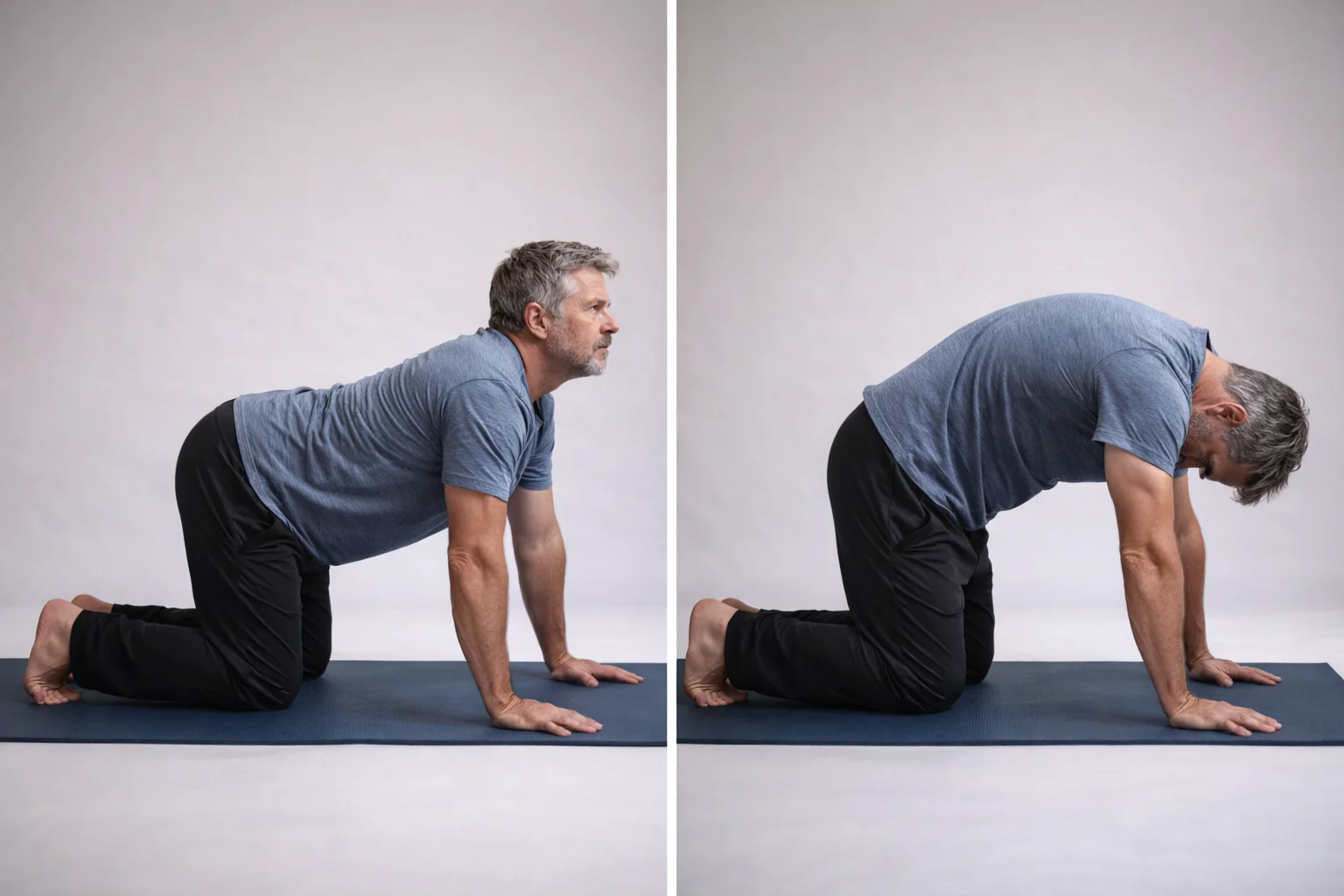
Your spine has 24 vertebrae that should each move independently. Years of bracing, tension, and protective posturing create "stiff segments"—areas where vertebrae move together as a block instead of articulating individually.
This movement teaches your spine to articulate segment-by-segment again:
- Alternating flexion and extension lubricates facet joints
- Engages deep spinal stabilizers (multifidus, erector spinae)
- Distributes synovial fluid throughout spinal joints
- Restores the "wave-like" quality that healthy spines have
The key insight: Your spine should move like a wave, not a plank. If you can't feel individual vertebrae moving, you're going too fast or too aggressively.
Why This Matters for Contractors
Forward-facing work creates spinal rigidity:
- Bracing while lifting locks the spine into protective patterns
- Hunching over workbenches flattens the natural spinal curves
- Vibration from power tools creates tension throughout the back
- Years of this creates a spine that moves as one stiff unit
Cat-Cow reverses this by asking each segment to move independently again.
How to Do It
Setup
- Start on hands and knees on mat or carpet
- Hands directly under shoulders, fingers pointing forward
- Knees directly under hips, about hip-width apart
- Spine starts in neutral—neither arched nor rounded
- Look at floor about 12 inches in front of hands (neutral neck)
Cow Phase (Inhale)
- Drop belly toward floor (spinal extension)
- Lift chest forward and up
- Lift tailbone toward ceiling
- Movement should feel like a wave starting at tailbone, moving through each vertebra to head
- Gently look forward and slightly up (don't crank neck)
Think: "Opening the front of the body"
Cat Phase (Exhale)
- Tuck tailbone under
- Round spine toward ceiling like a scared cat
- Drop head to look toward thighs
- Wave-like motion starting from tailbone, moving up through each vertebra
Think: "Hollowing out the belly"
The Movement
- Take 5-10 seconds per transition
- Move like someone is drawing a finger down your spine, and each vertebra moves only when touched
- Complete 5-6 full cycles (10-12 total positions)
Form Critical Points
- Wave, not plank: Each vertebra should move in sequence, not all at once
- Tailbone leads: Movement initiates from pelvis, ripples through spine, head follows last
- Breathe with movement: Inhale into cow, exhale into cat
- Slow is better: Speed destroys the segmental quality
- Feel mid-back: Most people only feel neck and lower back—actively try to feel mid-back moving
Jeff Cavaliere's Cue
"Imagine someone drawing a finger down your spine, and each vertebra moves only when touched. That's the speed and segmentation you want."
What It Should Feel Like
Normal sensations:
- Gentle pulling through spine with each position
- Sense of individual vertebrae moving (develops over time)
- Slight warmth in spinal muscles
- Increasing freedom of movement as you progress through reps
Should NOT feel:
- Sharp pain in any vertebra
- Pinching in lower back during cow
- Neck strain or headache
- Dizziness
Variations
Forearm Version (Wrist Pain)
If wrists hurt bearing weight:
- Drop down to forearms instead of hands
- Same movement pattern
- Less wrist load, same spinal benefit
Fist Version (Wrist Pain)
- Make fists instead of flat palms
- Bear weight on knuckles
- Maintains wrist neutral position
Standing Version (Knee Pain)
If kneeling is uncomfortable:
- Stand facing wall, hands on wall at shoulder height
- Hinge at hips for cow (arch back)
- Round back for cat
- Smaller range but still beneficial
Troubleshooting
Wrist pain when weight-bearing
- Solution 1: Make fists instead of flat palms, bear weight on knuckles
- Solution 2: Do on forearms instead of hands (more stable, less wrist pressure)
- Solution 3: Fold towel under heels of hands for cushioning
Knee pain from kneeling
- Solution 1: Double up mat, use thick folded blanket
- Solution 2: Wear knee pads (construction knee pads work great)
- Solution 3: Do standing version against wall
I don't feel anything
- Cause: Moving too fast, not isolating segments
- Solution: Slow down to 5-10 seconds per transition
- Focus: Can you feel your mid-back moving? Or just neck and lower back?
- Cue: Imagine vertebrae as piano keys—press each one sequentially
Lower back feels crunchy or compressed in cow
- Cause: Forcing excessive arch, compressing lumbar spine
- Solution: Think "lengthening" not "compressing"
- Check: Are hands truly under shoulders? Move them slightly forward to reduce lumbar load
- Alternative: Reduce range—don't go into full arch, just slight extension
Neck pain or tension
- Cause: Leading movement with head instead of tailbone
- Solution: Keep head/neck neutral initially, add gentle movement only after mastering torso
- Cue: "Tailbone leads, head follows"
Bram's Experience
Week 1: Could barely feel mid-back moving. Focused on just the obvious areas (neck, lower back). Movement felt choppy and mechanical. "Like trying to move a rusty chain."
Week 4: Could feel individual thoracic vertebrae articulating. Movement becoming smoother. Felt like spine was "waking up" after years of dormancy.
Month 3: Movement became fluid, natural. Morning spinal stiffness reduced from 45 minutes to 5 minutes. Could feel each segment moving independently—the wave-like quality finally present.
Long-term: This became Bram's diagnostic tool. When his back felt "off," he'd do cat-cow and immediately know which segments were stuck. "It's like checking in with my spine every morning."
Real-World Impact
"I didn't realize how much my spine had locked up until I started moving it again," Bram wrote in his journal. "Twenty years of bracing and protecting had turned my back into one solid block. Cat-cow taught me that each vertebra is supposed to move on its own. Once I understood that—once I could feel that—everything else started to improve."
Specific benefits:
- Morning routine: 90 seconds of cat-cow before getting out of bed eliminated the "old man shuffle" to the bathroom
- Work preparation: A few cycles before heavy lifting helped his spine be ready to move properly
- End of day: Evening cat-cow helped decompress the accumulated tension from the workday
- Body awareness: Developed ability to feel exactly where his back was tight or restricted
Integration
Cat-Cow is the first stretch in the Daily 8 because it prepares the spine for everything else:
- Warms up spinal joints before deeper stretches
- Activates spinal stabilizers
- Establishes body awareness for the session
- Takes minimal time but provides foundational benefit
Recommended: Do 5-6 cycles before progressing to the next stretch.
Next: Child's Pose with Lat Stretch →
Return to Daily 8 Overview | All Exercises