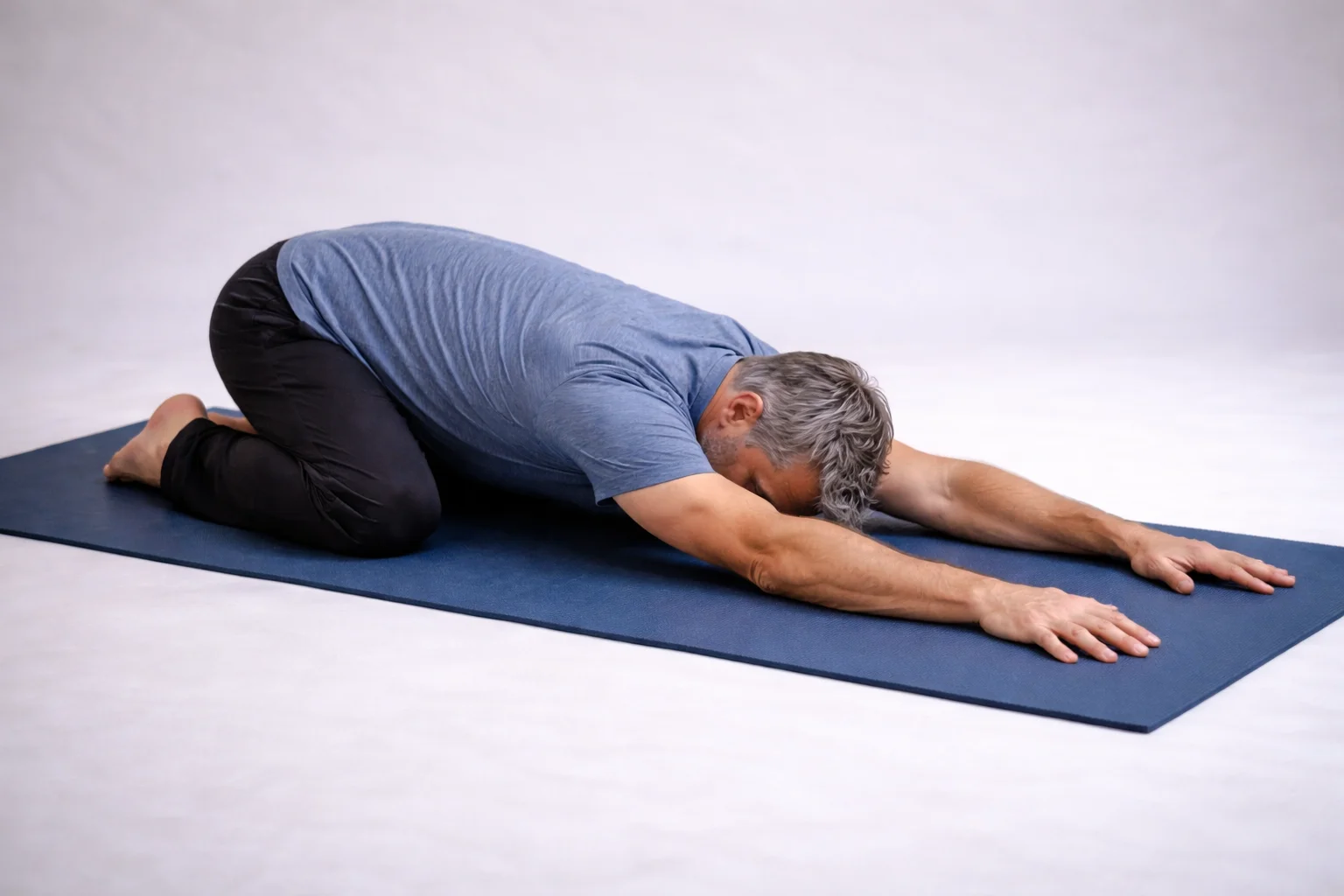
Child's Pose with Lat Stretch
Purpose: Decompress lower back, stretch lats and thoracic spine, create space between vertebrae
Duration: 2 minutes each side (4 minutes total)
The Biomechanics
The latissimus dorsi (lats) connect from your arms to your lower back. When tight, they:
- Pull the lower back into extension (arching)
- Restrict overhead reaching
- Contribute to shoulder impingement
- Create compensatory tension throughout the spine
Child's pose creates spinal traction—gravity gently pulls vertebrae apart—while the side-angling isolates the lat stretch on each side.
The key insight: Deep breathing in this position expands the ribcage against the stretch, creating passive release that you can't achieve through active stretching alone.
Why This Matters for Contractors
Every reaching movement—overhead drilling, lifting materials, pulling cables—engages the lats. Years of this creates chronic shortening:
- Can't reach overhead without arching the back (lat compensation)
- Lower back constantly pulled into extension
- Shoulder mobility restricted
- End-of-day compression and tightness
Child's pose with lat stretch addresses all of this in one position.
How to Do It
Setup
- Kneel on mat, knees wide apart (wider than hip-width)
- Big toes touch behind you
- Sit hips back toward heels as far as comfortable
- If too intense: Place folded towel or pillow between buttocks and heels
- Extend both arms forward on mat, palms down
- Forehead rests on mat (or on folded towel/block if can't reach)
Basic Child's Pose (30 seconds)
Stay here first, breathing deeply. With each exhale, imagine sinking deeper, spine lengthening. Let the whole back relax.
Adding Lat Stretch
Right side (2 minutes):
- Walk both hands to the right side, angling arms about 45° from center
- Keep hips centered—don't let left hip lift off heels
- Feel stretch along entire left side of body, particularly under left shoulder blade and down left lat
- Left arm is reaching diagonally across body
- Hold 2 minutes, breathing deeply
Left side (2 minutes):
- Walk hands through center to left side
- Right arm now reaching diagonally
- Feel stretch along right side
- Hold 2 minutes
Form Critical Points
- Hips stay back: The stretch comes from the diagonal reach while hips anchor backward
- Both sitting bones stay down: If opposite hip lifts, you've gone too far to the side
- Breathe into the stretch: Imagine breath expanding the ribcage on the stretched side
- Relax shoulders: Don't shrug—let shoulders melt toward the floor
- Forehead supported: If straining to reach floor, neck tenses, defeating purpose
Breathing Technique
This is where the magic happens:
- Inhale: Breathe deeply into the side that's being stretched
- Exhale: Sink slightly deeper, let the body get heavier
- Feel the expansion: Ribcage should move outward against the lat stretch
- Each exhale: Incrementally deeper relaxation
What It Should Feel Like
Normal sensations:
- Deep stretch along the side body (lat, obliques)
- Sense of spine lengthening
- Possible stretch into shoulder
- Decompression feeling in lower back
- Growing relaxation with each breath
Should NOT feel:
- Sharp pain in lower back
- Knee pain
- Neck strain
- Numbness or tingling in arms
Variations
Supported Version (Very Tight)
- Stack 2-3 pillows lengthwise
- Drape torso over pillows
- Arms can rest at sides instead of extended
- Much more passive, good for acute back pain
Single Arm Version (Deeper Stretch)
- Extend only one arm diagonally
- Other arm rests at side or under forehead
- More isolated lat stretch
- Can go further to the side
Thread the Needle Addition (Thoracic Rotation)
After basic lat stretch:
- Take right arm and thread it under left arm
- Right shoulder comes toward floor
- Adds thoracic rotation to the lat stretch
- Hold 30-60 seconds, then switch sides
Troubleshooting
Can't sit hips back to heels
- Cause: Knee or ankle restriction, tight quads/hip flexors
- Solution 1: Place folded blanket or pillow between buttocks and heels
- Solution 2: Reduce distance—don't need to sit all the way back
- Solution 3: Elevate hips with yoga block under buttocks
- Timeline: This improves over weeks—be patient
Forehead doesn't reach floor
- Cause: Tight hips, limited spinal flexion, or body proportions
- Solution: Stack fists, yoga block, or folded blankets under forehead
- Why it matters: If straining to reach floor, neck tenses, defeating purpose
- No shame: Many people need significant elevation
Don't feel lat stretch when walking hands to side
- Cause: Not angling far enough, or opposite hip lifting
- Solution 1: Walk hands farther to side (more than 45° if needed)
- Check: Both sitting bones should stay grounded
- Cue: "Spiral the ribcage toward the floor on the stretched side"
- Alternative: Do single arm only
Shoulders bunched up by ears, neck tension
- Cause: Not actively relaxing shoulders, poor breathing
- Solution: Actively relax shoulders down away from ears
- Breathe: Exhale and imagine shoulders melting toward floor
- Check: Are you holding your breath?
Lower back pain in this position
- Cause: Too much flexion for current spine tolerance
- Solution: Reduce range—don't sit back as far
- Alternative: Place pillow under belly for support
- Progress: Start with 30 seconds, gradually increase
Bram's Experience
Week 1: Couldn't sit back more than halfway. Forehead nowhere near floor—used stacked yoga blocks. The lat stretch was barely perceptible through all the other restrictions.
Week 6: Could sit back 80% of the way. Felt genuine lat stretch for first time. Started to understand what the stretch was supposed to target.
Month 3: Full range, could breathe deeply into back. This became his favorite stretch—felt like spine was getting longer with each session. The decompression after a day of work was profound.
Long-term: "This is the stretch that taught me what decompression feels like," Bram noted. "After years of compression from standing, lifting, working—this position lets gravity gently pull everything apart. I can literally feel my spine lengthening."
Real-World Impact
-
Overhead work: After three months of consistent lat stretching, Bram could reach overhead without his lower back arching. His shoulders did the work instead of compensating with his spine.
-
End-of-day relief: "I used to come home feeling like I'd been compressed in a vice all day. Five minutes in child's pose with lat stretch and I could feel the space coming back between my vertebrae."
-
Sleep quality: Doing this before bed helped decompress the day's accumulated tension, leading to better sleep and less morning stiffness.
Integration
Child's Pose is the second stretch in the Daily 8 because:
- Follows naturally from Cat-Cow (spine is warmed up)
- Transitions body from hands-and-knees to floor
- Prepares lats for later overhead/shoulder work
- Creates foundation of relaxation for the session
Recommended: Full 4 minutes (2 minutes each side) in evening routine. Can shorten to 2 minutes total in morning routine.
Next: 90/90 Hip Stretch →
Return to Daily 8 Overview | All Exercises